


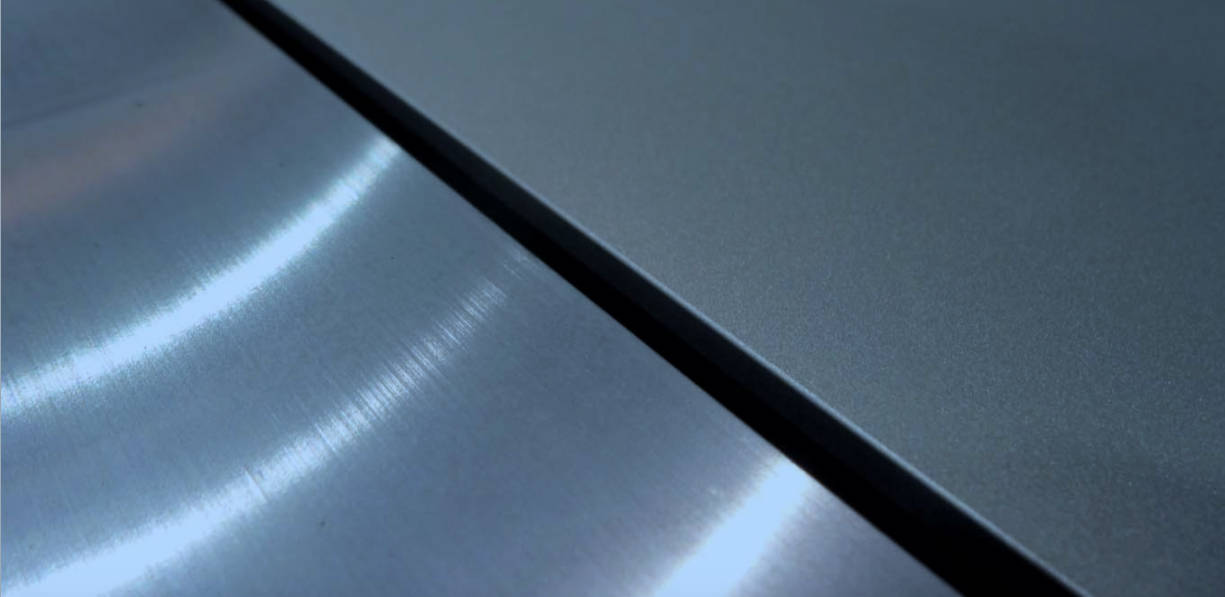
The mechanical pre-treatment of extruded aluminium profiles significantly reduces the pickling time while creating a pleasant, uniform satin effect.
A case study by Enzo Dell'Orto published on International Paint & Coating Magazine.
The most common surface treatment used for finishing extruded aluminium profiles has always been chemical pickling in a basic bath. The profiles’ complex shapes, their sensitivity, and the aesthetic perfection required raise several issues that make it difficult to employ alternative methods. On the other hand, the use of caustic soda-based chemicals entails a large number of disadvantages due to the need to handle toxic solutions and properly dispose of their related waste water, as well as to the significant erosion of precious material that must be recovered with further processes.
In a global context where the demand for aluminium products is constantly growing, all of this calls for a change of paradigm in order to increase productivity and reduce costs, of course without affecting quality. A solution that has been successfully tested by major manufacturers of extruded aluminium profiles is a pre-treatment phase with a mechanical shot blasting process performed in an automatic turbine system, followed by a quick immersion in an alkaline bath to complete the finishing treatment. Shot blasting quickly eliminates most of the surface defects generated by extrusion and handling operations, while creating a pleasant, uniform satin effect (ref. Opening photo). The subsequent pickling phase, therefore, has a mere finishing function, thus being much more delicate.
Some product characteristics, however, make it difficult to get optimal results. First of all, profiles have complex shapes and, therefore, they require careful positioning of the turbines in order to obtain a uniform finish. Secondly, the parts are generally very thin and thus susceptible to shot peening-induced deformation when subjected to mechanical stresses. Finally, in order to preserve their aesthetics, any contact of the profiles with the machine’s metal elements should be avoided. In order to meet all these requirements, OMSG – Officine Meccaniche San Giorgio Spa (Villa Cortese, Milan, Italy) has developed a special range of shot blasting systems called LAUCO 80/30 (Fig. 1), able to effectively treat any type of extruded aluminium part. As always, the core of the shot blasting plants are four high-performance centrifugal turbines patented by OMSG, each with an installed power of 15 kW, projecting more than 900 kg of abrasive per minute. The turbines are mounted on the central body of the shot blasting machine and they are specially arranged and inclined so that the whole workpiece is perfectly treated.
A special conveyor made of rubber rollers (Fig. 2) moves the workpieces through the shot blasting chamber. Two pressure rollers block them from above, maintaining their position, alignment, and distance. If needed, a third pressure roller can be added to enable the treatment of particularly short profiles, up to a minimum of 2 metres. Due to the need to use a fine, stainless steel abrasive composed of very small-sized spherical grains, the suction system is suitably sized to avoid its dispersion with the dusty air flow, thus minimising waste.
At the exit of the machine, the workpieces are automatically transferred sideways on a special hydraulic lifting system parallel to the exit roller conveyor. This device tilts them to remove all the abrasives stuck in their internal grooves and channels (Fig. 3); the stainless steel abrasive is then automatically returned to the shot blasting machine.


The choice to move the parts sideways maximises the productivity of the plant, quickly freeing up the exit roller conveyor and concealing the time required for the tilting of pallets and the removal of abrasives. In this way, the pitch between batches can be limited to a few seconds.
As per OMSG’s tradition, this shot blasting system is extremely robust, built with the highest quality materials, and advanced in terms of engineering solutions. It is equipped with a PLC that accurately sequences the work phases, sophisticated sensors for positioning control, and effective field diagnostics based on a PROFINET interface. A practical and user-friendly touchscreen interface enables the operator to manage the system effectively, check its performance, and watch synoptic graphics about the system status. Particular attention was paid to the dust extraction system.
Given the characteristics of the particulate, normally very fine and with a high percentage of aluminium, the most effective safety systems have been adopted to avoid explosion.
An effective two-stage argon fire extinguishing system can be added to also avoid fire.
Now, what are the real advantages of the combined cycle compared with the conventional, chemical-only treatment? This is the main question asked by customers before deciding to purchase this turbine shot blasting machine. Mechanical pre-treatment significantly reduces the pickling time. Although this can vary greatly depending on the type of finish required, it is decreased by about 80%.
In other words, if a chemical-only treatment takes 20 minutes, the finishing pickling process after shot blasting may last only 4 minutes.

This evidently ensures three benefits:
- limited size of the plant and production area;
- reduced total processing time;
- reduced dispersion related to the material corrosion.
This increases productivity and overall efficiency. In particular, it is possible to obtain a production increase of over 15%, while a recurring cost reduction of around 20% (for the same tonnage produced) can be expected. Besides these economic advantages, another significant advantage of this solution is its much lower environmental impact, as it greatly reduces the amount of sludge to be disposed of. The combined treatment proves therefore to be a simple, modern, and feasible way to innovate and make the treatment of extruded aluminium profiles more competitive while saving and avoiding giving up quality.
 Polski