


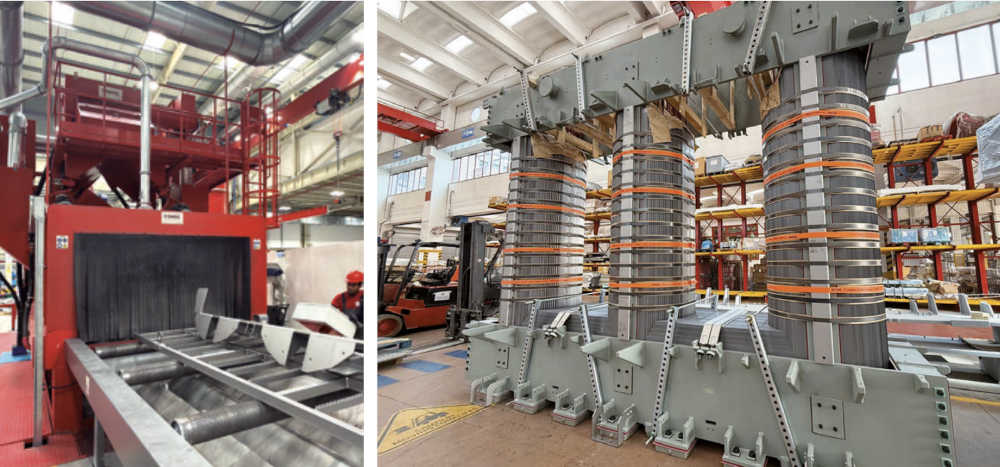
The long-standing partnership between LTC – Legnano Teknoelectric Company S.p.A., which has been manufacturing magnetic cores for power transformers since the late 1950s, and OMSG – Officine Meccaniche San Giorgio S.p.A., a supplier of shot blasting plants, has grown stronger over time and even extended to LTC’s production sites abroad.
Article by M. Fumagalli, Corrosion Protection magazine, no. 12 (October 2025), pp. 42-48 ipcm® International Paint&Coating Magazine ®
A mechanical department integrated with high-efficiency shot blasting systems: LTC’s choice to ensure the durability of its magnetic cores.
For this project, LTC decided to rely on OMSG – Officine Meccaniche San Giorgio S.p.A., located in Villa Cortese (Milan, Italy), a few kilometres from its headquarters, which has been manufacturing shot blasting machines and automatic sandblasting systems since 1961.
A complex product manufactured using diversified production cycles in different plants: magnetic cores are the core business of LTC – Legnano Teknoelectric Company S.p.A., a global leader in the production of these components for a wide range of transformers and reactors. These are in fact the cores of transformers: they consist of electrical or magnetic steel laminations and are the fundamental element around which the primary and secondary electrical windings are arranged, guiding and concentrating the generated magnetic flux.
Various surface treatments can be performed on this type of product. Where required, a layer of insulating and protective paint is applied to the magnetic sheets to prevent oxidation without altering the material’s magnetic properties; the ideal paint type, its uniformity, and its controlled thickness are essential to reduce eddy currents and ensure durability. The standard steel metalworking that makes up the frame and core kit, on the other hand, can be galvanised and coated to increase the film’s anti-corrosive properties and, therefore, the surface coating’s durability.
This is where mechanical pre-treatment by shot blasting plays a strategic role, improving coating adhesion and evening out the surfaces, thus ensuring long-term resistance and protection even under harsh operating conditions.
For this project, LTC decided to rely on OMSG – Officine Meccaniche San Giorgio S.p.A., located in Villa Cortese (Milan, Italy), a few kilometres from its headquarters, which has been manufacturing shot blasting machines and automatic sandblasting systems since 1961.
LTC - Legnano Teknoelectric Company S.p.A. is located between the municipalities of Legnano and San Giorgio su Legnano. Its entire range of operations, from the longitudinal cutting of magnetic steel sheets to the production of steel components for the assembly of finished cores for transformers, is carried out in over 60,000 m2 of covered facilities. In Italy, the Group has five plants employing 650 people, of which four are devoted to magnetic cores and one to metal components, with a sixth due to start construction next year. In Dubai (United Arab Emirates), LTC operates two plants covering an area of over 30,000 m2, which were launched between 2011 and 2012 with the same production structure and, in particular, the same OMSG shot blasting systems used at the Legnano site. The Taiwan site has been operational since July 2023, and a new greenfield plant is under construction in Canada.
“We have supplied LTC with three shot blasting plants at this site and three identical plants at the Dubai site,” illustrates Enzo Dell’Orto, the CEO of OMSG. “These are a CAPRI 30/60 H25 hoist shot blasting machine, an SG6 H2 Tappeto Rampante® steel belt tumblast shot blasting machine (both installed in 2019), and a LAUCO 2010/8 roller conveyor shot blasting machine installed in 2023.”
The cleaner the surfaces, the greater the coating adhesion, a determining factor for durability, especially for components intended for harsh conditions, such as marine corrosion or direct exposure to atmospheric agents.
“We perform shot blasting with three automatic systems, selected according to the size of the workpieces, before and after welding,” explains Lorenzo Mendicino, the Plant Manager of Plant 2. “The first phase serves to remove oxide and scale after cutting and aims to avoid contaminating the emulsified water used in the machines. The second phase, on the other hand, is performed after welding and prepares the surfaces for the subsequent galvanising and/or coating operations (which we outsource) by improving the adhesion of the protective layer. Another important process is the rounding of edges using dedicated automated systems, an essential detail in our sector, as rounded edges are considered an indicator of quality. Indeed, our goal is to maintain the highest possible level of quality to offer the best product on the market.”
In more detail, the CAPRI system is equipped with two hoists that lift parts up to 5,000 kg. It uses seven turbines, each with a power of 11 kW, to shot blast components with a maximum diameter of 3,000 mm and a height of up to 6,000 mm, which are rotated within its chamber. The Tappeto Rampante® steel belt tumblast shot blasting machine has a 600-dm3 capacity and a maximum throughput of 2,000 kg, and it is designed for treating small parts. “Its peculiarities,” notes Dell’Orto, “include the two-cylinder hydraulic skip loader and the part unloading system using a vibrating channel.”
The LAUCO 2010/8 roller conveyor system, parallel to the plasma cutting machine, has a 2,000 mm-wide and 1,000 mm-high shot blasting section, eight 11-kW turbines, and 9-metre inlet and outlet roller conveyors. It is also equipped with a brushing and blow-off unit at the outlet to remove any abrasive residues from the parts. “We also design all our plants in accordance with Industry 4.0 parameters,” states Dell’Orto.
Bertelli emphasises: “We were so pleased with the performance of the OMSG systems that, when it came to duplicating our production system at the site in Dubai, we requested the same set of shot blasting machines.
Text and images from the article by M. Fumagalli, Corrosion Protection magazine, no. 12 (October 2025), pp. 42-48 ipcm® International Paint&Coating Magazine ® - all rights reserved
 Russian